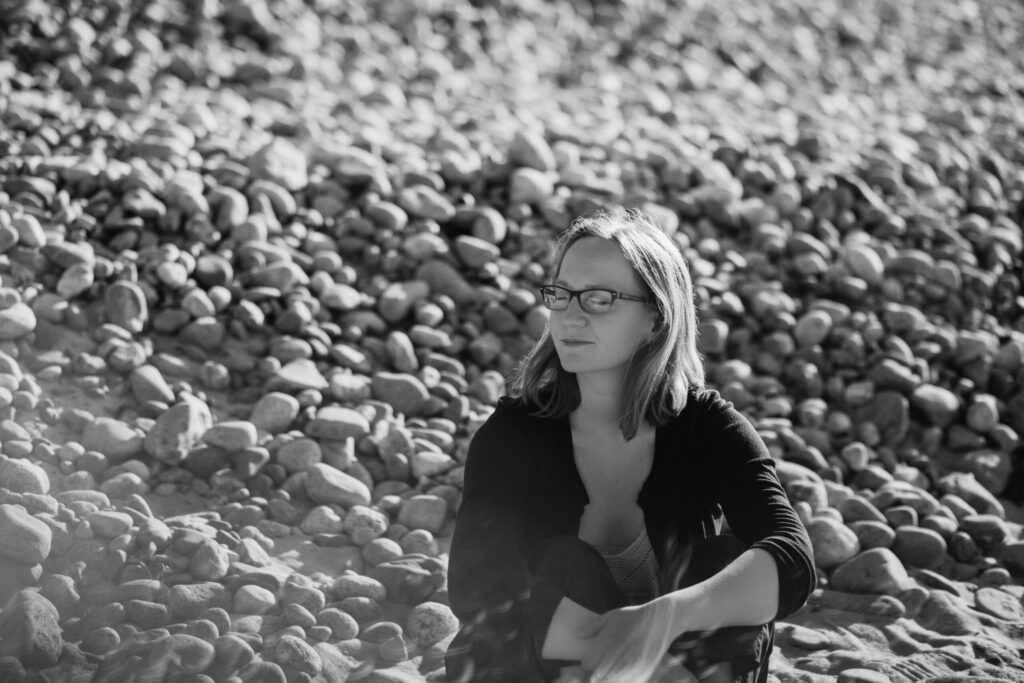
On Saturday, 8 November, The Carice Singers will give a concert at London’s Barbican to celebrate Arvo Pärt’s 90th birthday. The programme features a selection of Pärt’s works, as well as music by Galina Grigorjeva and the world premiere of Evelin Seppar’s new piece “Kuskil maailma äärel” (Somewhere at the edge of the world), written especially for the choir, alongside Seppar’s works Seesama meri, Psalm 129, and Iris.
Concert info:
The Carice Singers: Infinity Flow
Barbican Centre, London
8 November 2025
Lisainfo: barbican.org.uk/whats-on/2025/event/the-carice-singers-infinity-flow
The concert will be conducted by George Parris, who interviewed Evelin Seppar about her work, her collaboration with The Carice Singers, and the ideas that inspired her in creating the new piece.
What are some of the highlights of your career so far?
I think there have been different kinds of highlights. First of all to get commissions and performances from world-renowned professional groups like the Netherlands Chamber Choir or Estonian Philharmonic Chamber Choir has been very special. And in the last couple of years receiving commissions from professional orchestras has also meant a great deal to me.
Another type of highlight I can only see in hindsight. It’s pieces that I have mostly withdrawn from my list of works, but which have taught me a great deal. It is very difficult to take risks as an artist – you can never be sure of the outcome and there is always a fear of the unknown. But in these risky moments you learn the most and discover something new, either about yourself or your work, or about both. Sometimes the result can be an incredible piece of music, and sometimes it simply doesn’t work out. We live in a very much success-driven world and even artists are expected to deliver every single time. But for me music is a living organism, it has a mind of its own. So the highlight is when I dare to go with what my music wants, and I manage to set all expectations and fears aside.
And last but not least, a great highlight has been to get to know and work with all the musicians that I’ve met along the way in different parts of the world. Composing is a very lonely profession, so to interact with musicians is wonderful, and also necessary. They bring to life what I’ve made and are a mirror for me to understand my craft better.
Are there any particular places that are special to you and your work?
I think places used to be more important than they are now, like certain concert halls or churches with special acoustics. Now these have been replaced by people – if the musicians are engaged and devoted and interested, then they can make any place special. Without them a place is just an empty space. And if I think outside of music then the sea is the most special place to me. It is a place I am in awe of, where I can always recharge and that I love tremendously.
How do you feel when you compose?
That depends on which part of the composing process I am in. Composing is always an emotional rollercoaster, coming face to face with myself, so it’s never easy. Beginnings are always hopeful – with every new piece there is the hope of “this will be my best piece so far”. Then, when I need to get more concrete about my ideas and have to set them to actual notes, as opposed to the vague ideal in my head, it gets difficult. To put pen to paper and actually make something tangible makes it real, and because of that open to criticism. So the first drafts usually get thrown out, they are not good enough. Afterwards when something more acceptable starts to emerge I get hopeful, there is a possibility that I am making something good. And then this relentless work begins, endless searching and adapting and changing, until I get it just right. There are lots of ups and downs in that part as well, ranging from “I’ve found something I love” to “I have no idea how to continue and I’m completely stuck, I should find another job”. But then it gets done somehow. And the final test is working with the performers – to hear if it actually works, and if it can come to life outside of my head as well.
Why have you been so drawn to the poems of Jaan Kaplinski?
I find some of his poems very moving, and he writes about topics that I also find important – nature and how we relate to it and our existence in this world as human beings. He manages to write about life in a seemingly simple way, yet there are always many layers, a lot to think about. His poems reflect what a knowledgeable person and great thinker he was and what a versatile writer as well.
The concert’s title is ‘infinity flow’. How do you relate to this idea, if at all, in your music?
I often try to make longer stretches of music that unroll harmonically slowly, yet have a busier texture, and it could seemingly go on forever. The basic idea is a kind of infinitely flowing music. But no one would be able to perform that, or would want to listen to that (myself included), so the musical material needs to go somewhere, evolve, change to something else, or resolve.
Another thought about ‘infinity flow’ is perceiving other composers’ music like that – it is part of the air, part of time and space. It simply comes from somewhere and goes somewhere in the most natural way, like it has been there all along. The music of Bach is
like that for me.
You came to the UK in 2022 and heard The Carice Singers rehearse and perform your Psalm 129. How has that experience influenced you in composing this new work for the same group?
I didn’t know the group personally back then, it was lovely to get to know the singers and George. I have very warm memories of that time. I remember I was completely blown away by their sound and their capability to shift to the next gear if I asked for it. I hadn’t experienced that with other professional groups to such an extent, it was fantastic! To get what you ask for 100% as a composer is not so common. So it’s an honor that they wanted to collaborate with me more, and I’m still happily composing for them.